
2025 Reducer Industry Development Trend Analysis
2026/02/04
1. Intelligence and Digitalization
Integrated Sensors & IoT Technology: Reducers will increasingly be equipped with vibration, temperature, and load sensors to monitor operational status in real-time. Predictive maintenance will be achieved through the Industrial Internet of Things (IIoT), reducing downtime.
Digital Twin Technology: Virtual models will be used to optimize design and simulate actual working conditions, enhancing product performance and lifespan.
Smart Lubrication & Adaptive Control: AI algorithms will automatically adjust lubrication cycles or load distribution to improve energy efficiency.
2. High Precision and High Performance
Precision Reducers for Robotics: Growing demand for collaborative robots (Cobots) and industrial robots will drive the lightweight and low-backlash design of RV reducers and harmonic drive reducers.
High-End Manufacturing Sectors: Industries such as semiconductor equipment and medical machinery require nanometer-level transmission accuracy, prompting reducers to develop towards ultra-high rigidity and low noise.
3. Energy Saving and Green Manufacturing
Material Innovation: The use of high-strength composite materials or lightweight alloys (e.g., magnesium-aluminum alloy) to reduce weight and lower energy consumption.
Upgraded Energy Efficiency Standards: Compliance with international energy efficiency regulations (e.g., IE4/IE5 motor matching requirements), optimizing gear design to reduce friction loss.
Lubrication Technology Improvements: Bio-based lubricants or maintenance-free designs to minimize environmental pollution.
4. Modularity and Customization
Rapid Adaptation Needs: Modular design allows customers to flexibly combine parameters like reduction ratio and shaft type, shortening delivery cycles.
Industry-Specific Solutions: Development of specialized reducers for scenarios such as wind power, AGV logistics, and aerospace.
5. New Processes and Manufacturing Technologies
3D Printed Gears: Used for small-batch production of complex structures, shortening R&D cycles.
Ultra-Precision Machining Technologies: Processes like gear grinding and honing improve gear surface precision and extend lifespan.
6. Driven by Emerging Application Fields
New Energy Industry: Large-scale and corrosion-resistant wind turbine gearboxes; integrated motor/controller functions for electric vehicle reducers.
Humanoid Robots: Products like Tesla's Optimus may spur demand for new types of compact reducers.
7. Supply Chain and Regionalization
Localized Production: Geopolitical factors accelerate the localization of reducer industry chains in regions like China and Southeast Asia.
Cost Competition: The mid-to-low-end market shifts towards more cost-effective domestic alternatives (e.g., Chinese brands replacing Japanese and German products).
8. Standardization and Collaborative Development
Formation of Industry Alliances: Leading companies (e.g., SEW, Sumitomo, Guomao) may jointly establish communication protocol standards for intelligent reducers.
Challenges and Opportunities:
Technical Barriers: Precision reducers (e.g., harmonic drives) still rely on imported materials (e.g., special steels). Domestic substitution requires breakthroughs.
Cross-Border Competition: Motor companies (e.g., Siemens) may integrate reducer businesses to provide integrated power solutions.
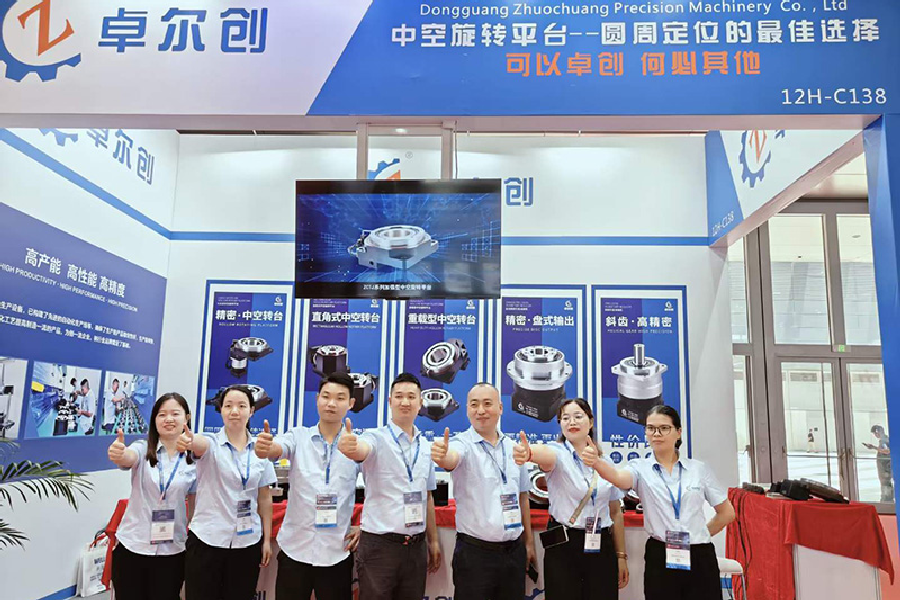
In 2025, the reducer industry will accelerate its transformation towards "intelligence, precision, and green manufacturing," while adapting to the diverse demands of high-end equipment and emerging markets. Technological innovation and industry chain collaboration will become the core of competition. Zhuochuang Precision Machinery Co., Ltd. is a manufacturer specializing in the R&D, production, sales, and service of hollow rotary platforms and reducers. Our products feature advantages such as high precision, high torque, high efficiency, low noise.